Reporters' shield law dies on point of order;
JW experts urge carrying on the fight
The Texas Free Flow of Information Act (SB 966), commonly called the reporters' shield law, died in the Texas House of Representatives in the last days of the 80th regular session because of objections raised on a technical point of order.
This landmark bill, which had passed the Texas Senate on May 2, would have given journalists limited protection against compelled court testimony or disclosure of confidential sources. Reporters' work products, such as notes and tapes, would also have been protected by this limited privilege.
The intent of the bill was to protect significant journalistic investigations that often rely on confidential information from "whistleblowers" and other sensitive sources. Under the provisions of the bill, a judge considering ordering disclosure of confidential sources or work product from a journalist would have been required to weigh specific guidelines as to whether the disclosure would provide essential evidence to the case in question. Thirty-three other states in the U.S. already have similar shield laws, leaving Texas in the minority on this issue.
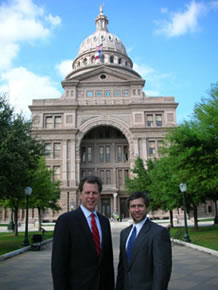
Paul Watler (left) and Bob Latham testified at the State Capitol in support of the reporters' shield law
The bill's sponsor, Senator Rodney Ellis (D-Houston), expressed disappointment that the bill was defeated "on the most trivial of technicalities." He vowed to continue the push to pass a similar bill. "Passing a Free Flow of Information Act will remain one of my top priorities," he said in a statement. "I fully plan to bring this issue back before the legislature next session and to gain more supporters."
Partners in Jackson Walker's media practice, including Chip Babcock, Paul Watler, and Bob Latham, echoed Senator Ellis's statements. The three attorneys, who have supported the shield law by testifying before House and Senate committees, working with the Texas Association of Broadcasters and the Texas Daily Newspaper Association to craft arguments and plan strategy, and visiting key legislators to advocate for the bill, agreed that the move to pass a journalist shield law in Texas should continue.
"A shield law is critically important to journalists in Texas," said JW partner Paul Watler. "We need to ensure that outstanding investigative reporting can continue." Watler specifically referenced the exploration of the Texas Youth Commission scandal recently undertaken by Jackson Walker client The Dallas Morning News, the "fake drugs" scandal uncovered by JW client WFAA-TV in 2002, and the Firestone tire recall reported by JW client KHOU-TV in 2000 – all essential journalistic efforts that served the larger community.
If you have any questions about this e-Alert, please contact Paul Watler at pwatler@jw.com or 214.953.6069.
----------------------------------------------------------------------
If you wish to be added to this e-Alert listing, please CLICK HERE to sign up. If you wish to be removed, please reply to this e-mail with REMOVE in the subject line and include your first and last name.